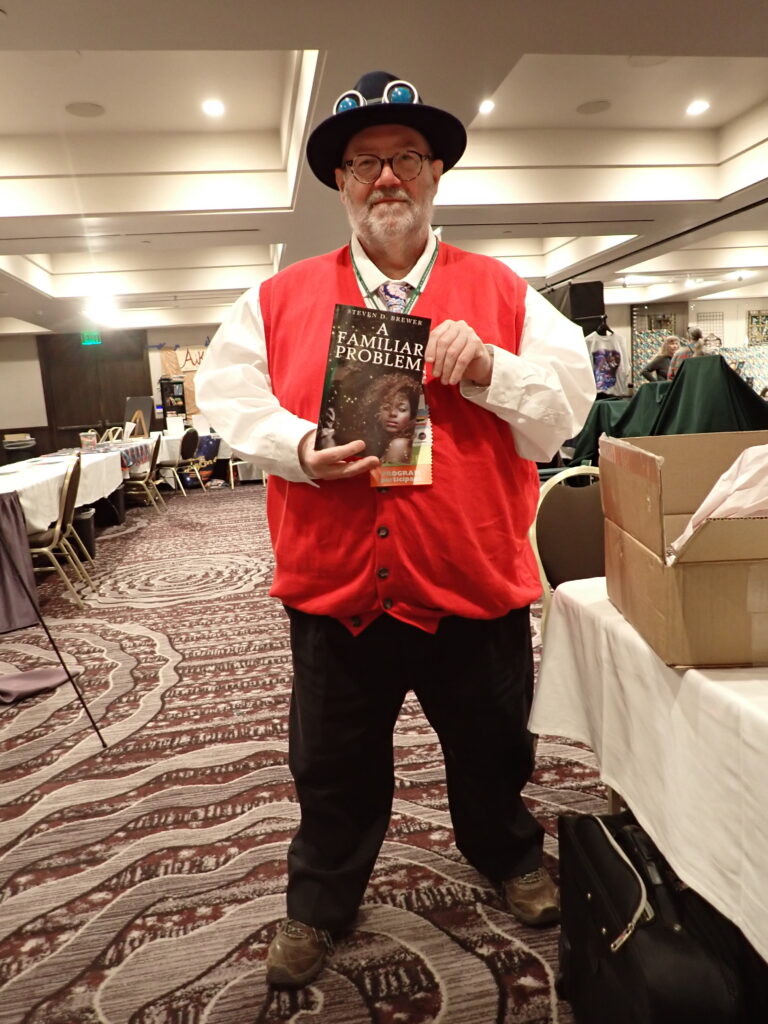
name tag and lanyard

My first appearances of 2026 have been scheduled! Some of these are still preliminary and may change, but I wanted to get them out in time to share in my January newsletter.

At Arisa 2026 (January 16-19), I am scheduled to moderate one panel and serve on four others:

Manga 101: Introduction to Japanese Comics
Kendall Square Saturday, January 17, 2026, 10:00 AM EST

Don’t Know Much About Geography–But You Should!
Porter Square A Saturday, January 17, 2026, 5:30 PM EST

Artist, Craftsperson, Maker, Crafter, Hacker – What’s in a Name?
Central Square Saturday, January 17, 2026, 6:45 PM EST

Your Fat Friends
Porter Square A Sunday, January 18, 2026, 10:00 AM EST

Isekai 101: Surviving Your Time In Another World (moderator)
Harvard Square Monday, January 19, 2026, 10:00 AM EST

There is still a chance I will get an opportunity to read at Arisia. The schedule is still being finalized.

On January 31, I have been selected to read from A Familiar Problem at the Straw Dog Writers Guild Author Showcase at 4pm at the Forbes Library in Northampton. I will also be bringing copies of my books to sell!

Later in the year, I’m tentatively planning to attend Watch City, the Nebula Conference, and Readercon again. I’m also proposing myself to be a participant at Worldcon. I’ll post further updates as we get closer!

sand dollar

Writing is easy. Getting published is hard. Getting published again is harder. But it’s sure easy to get discouraged.

During the 2025 Nebula Conference, I attended a workshop by Becca Syme of Better Faster Academy about career longevity among writers. Up front, she delivered the startling statistic that 80% of writers give up within three years. Her presentation focused on helping people set more realistic expectations and persist in the face of adversity. (Note: Her presentation, The Longevity Blueprint: Building A Career That Lasts, was really excellent and is still available to watch, but only for Nebula or Quasar attendees — or SFWA members. Note: you can still join SFWA or register for the upcoming Nebulas to gain access.)

The worst thing about publishing is that it’s stochastic. Outcomes are largely decoupled from inputs. You can do everything right and still not get published. Until you recognize that and internalize it, you’re setting yourself up for disappointment. Getting rejected really only means that this editor didn’t need this manuscript this time.

Still, I’m reminded of the Stupidity Demotivator: Quitters never win, winners never quit, but those who never win and never quit are idiots.

The real question, I suppose, depends on what one means by “winning”…

Many, many years ago my brother and I discussed career paths. His approach was to work at a job he hated, but which paid well, with the goal of saving enough to be able to retire early so he could do whatever he wanted. He retired around age 50 and has been “doing whatever he wants” for more than 15 years now. By contrast, my approach was “do what you love and you’ll never work a day in your life.” I found a career that was meaningful and satisfying and, although it was a lot of work (I aimed for 50-55 hours per week), it was work I generally enjoyed and found rewarding.

For me, my authorship is the same. I don’t write aiming to make a lot of money. I do it because I find it satisfying. I love to write. It makes me happy.

I’m sad, however, when I think of all the people who’ve crashed out. Who came to the party with high expectations and ended up going home alone. I wonder where you’ve gone and what it might take to get you to come back.

As I move toward full retirement, I’m devoting an increasing amount of my effort to trying to build sustainable communities to support writers. Straw Dog Writes, Wandering Shop Stories, and my work for SFWA all fall under this category. But they only address one side of the equation.

The money is harder. Economic forces are squeezing the publishing industry — and writers even more. Sociocultural shifts have resulted in fewer people buying and reading magazines and books. And now, Generative AI is flooding the marketplace with slop, making it that much harder for a new author to get discovered among the noise.

I remember Elizabeth Bear commenting that writers aren’t competing with one another: writers are all competing with the six-pack of beer at the party store for a purchaser’s dollar. I liked that way of looking at it. One of my goals for the coming year is to spend less money on beer and more buying books and then writing about them. Look for that here in the coming year. I hope you’ll still be here.

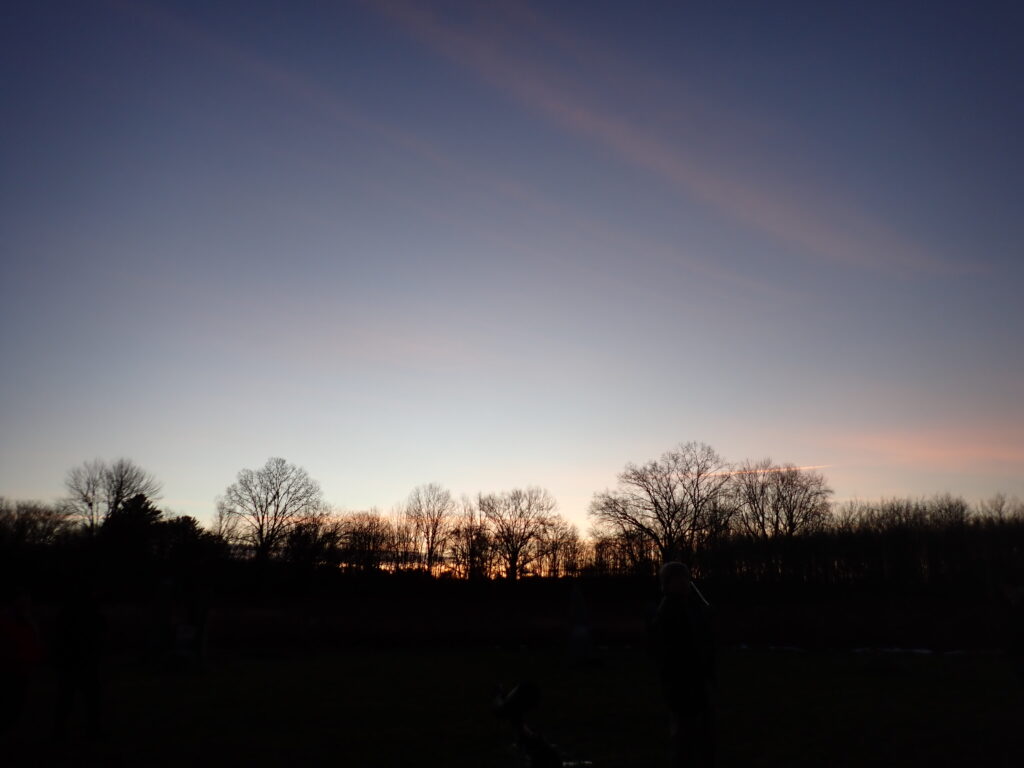
the morning sky on the solstice shortly before sunrise

When I awoke before dawn on the solstice, I checked the weather (there is a weather station at the Computer Science building, about a quarter mile from my house). The temperature was already above 39°F and I thought, “Ya, know. I could get up, have a leisurely cup of coffee, and still go to watch the sunrise at the UMass Sunwheel.

Both my brother and I have always been intrigued by sun-aligned structures. I still recall getting up very early to drive from St. Louis to the Cahokia mounds to watch the 1991 winter solstice sunrise with him and his wife. I have previously visited a number of indigenous sun-aligned constructions when I was a young man. Serpent Mound in Ohio appears to have sun-aligned components. When my wife and I were in Mesa Verde, we visited the Sun Temple. And many others over the years.

The Sunwheel project had started in 1992-93, and was just getting sited when I arrived at UMass in 1996. I remember I took my young children to one of the solstice sunrise presentations there. But I hadn’t been to a sunrise for a long time.

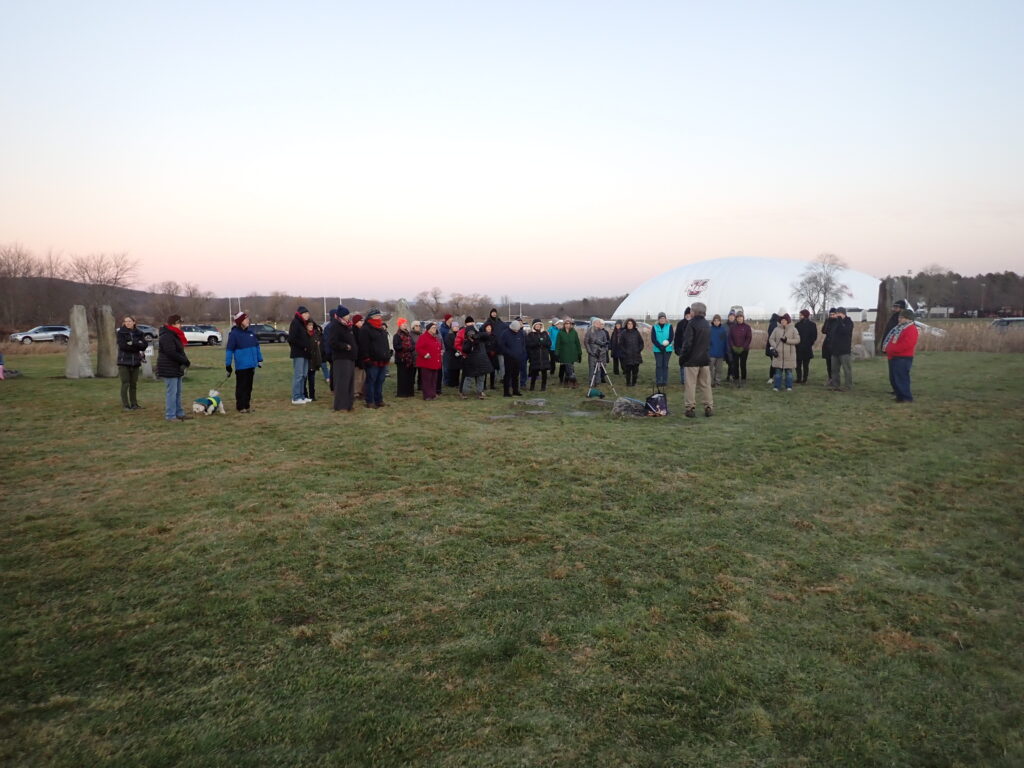
I arrived a few minutes before sunrise and joined a crowd of forty or fifty people who had come to watch the sunrise. I was pleased to see a colleague I knew from way back was there to do the presentation. He did a fantastic job of explaining how the axial tilt of the earth produces the change in apparent movement of the sun across the sky. And, combined with the elliptical orbit of the earth, results in the changes in times of sunrise and sunset around the solstice. As he joked, he wishes people a happy solstice and perihelion during the season. He introduced the Sunwheel and told us a bit about it’s history. He pointed out other standing stones that showed moonrise and moonset. For extra credit, he also explained how the precession of the orbit of the moon results in changes in where the moon rises and sets relative to the sun. He ended up, pointing out the stone that marks where the star Sirius sets, which the ancient Egyptians used to mark the flooding of the Nile.

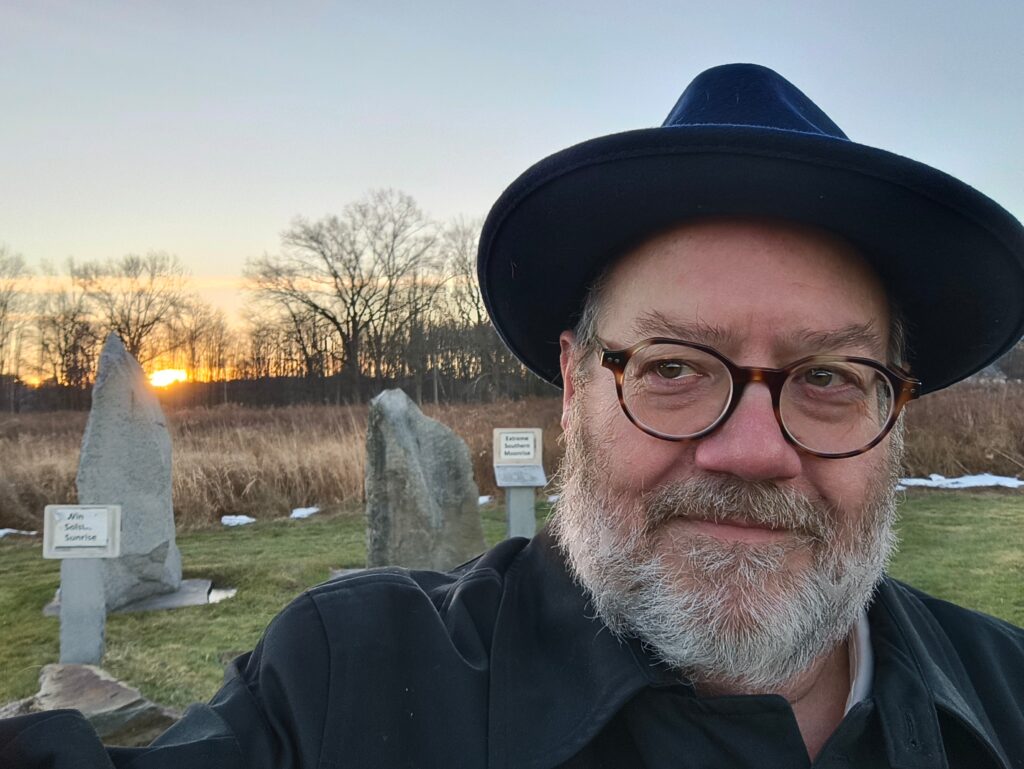
an older man wearing a hat in front of sun-aligned standing stones watching the sun rise on the winter solstice.

As he finished, the sun began to peek above the horizon. I took a few more pictures, chatted with a few people I knew, and then took my leave. It was a great start to the winter solstice, when the sun finally begins it slow passage back to the north.

a stylish hip flask

It’s become nearly impossible to avoid “AI” which is increasing shoehorned into every corner of our lives. I’ve lived through a bunch of the tech bubbles and this is by far the biggest and most intrusive. The tech-bros are convinced that robot slaves will print money for them so they can do away with all of these inconvenient human resources, impoverish them, and make them traffic their children for sex. Or, maybe, that’s just what they want you to think — to keep the bezzle going. But the fact of the matter is that today it’s nearly impossible to do anything using technology that hasn’t been tainted by so-called AI.

It seems apparent to me that the techbros have been intentionally enshittifying tools (like search) to force people to become dependent on AI. I suspect they are also using the huge pools of venture capital at their disposal to literally pay companies (cough Mozilla cough) to put AI into everything so that it becomes impossible to avoid.

It’s becoming harder and harder to define exactly what is AI. Some people distinguish between analytical and generative AI. Or what the model is trained with. Or where the model is run. I’m quite sure that almost no-one, outside of narrow specialists really has a good understanding. I think it’s all worth avoiding.

As an author, I strive very hard to stay away from AI. I don’t use any of the AI chatbots. I’ve used ChatGPT exactly one time. I want my writing to be unequivocally my own. I certify as such when I submit a manuscript. Toward that end, I don’t use computer operating systems with AI installed (I use Pop!_OS and an older version of the MacOS.) I have managed to retain the Google Assistant, turning off Gemini whenever they turn it on. I use the NoAI Duck Duck Go search engine. I have all of the AI bullshit turned off in Firefox. I do most of my writing in a text editor that doesn’t have AI (although there are AI plugins you can install). I’m using the wp-disable-ai plugin for WordPress to remove the interface elements that are based on generative AI. I turn off the AI Companion in Zoom. etc, etc, etc.

That said, I also use tools where it is nigh-on impossible to completely avoid AI, like Google Docs. Or Google Image Search. Or Google Maps. As Philip Brewer commented to me:

You know, it’s just about impossible to do anything on the internet and not end up using LLMs. If I use Google to check and see if there’s already a company with the same name I’m thinking to use as the name of a nefarious company in my story, Google is going to give me an AI-fied version of the search. If I read that, and then (depending on the result) either go with my fictional company name or else change it to some other fictional name, is my work now a work that used an LLM?

I don’t avoid AI only because of my authorship. I also want to make sure I’m using my brain and not becoming dependent on machines to think for me. I suspect people will discover that it is exactly like with GPS systems: There is “concrete evidence supporting the abstract contention that the rising technical order of GPS systems is dissipating human mental order in those who come to increasingly use and depend on it.” (From J. Robbins, “GPS navigation…but what is it doing to us?,” 2010 IEEE International Symposium on Technology and Society, Wollongong, NSW, Australia, 2010, pp. 309-318, doi: 10.1109/ISTAS.2010.5514623 — see A. Hutchinson, “Global Impositioning Systems: Is GPS technology actually harming our sense of direction?” The Walrus, Oct. 14, 2009. http://www.journals.uchicago.edu/doi/abs/10.1086/432651). This is not to say that I never use GPS systems, but I try to minimize my use — using them only when absolutely necessary — because becoming dependent on them causes the parts of your brain that do that work to atrophy. Literally.

I also avoid the commercial AI systems because their creators and operators are manifestly untrustworthy. You can’t know whether the results they’re presenting to you have some hidden bias. Or an overt bias. Sometimes that bias may be as simple as, “This restaurant paid us more money to have them show up in your Google Map results.” But there are a lot of other far more subtle potential biases that might be intentionally programmed in for political or ideological purposes. I would much rather be able to inspect the underlying data directly and make my own decisions. Search engines allowed us to do that. AI summaries do not.

People are going to need to come to their own decisions about what kinds of AI use are acceptable and unacceptable. I recognize that I tend toward one extreme. But others may reasonably tend toward another. Context is important.

It is not just a slippery slope. I remember many years ago, I went bicycling with my brother on the KalHaven rail trail, that runs from Kalamazoo to South Haven, on the Lake Michigan shoreline. We rode out, making good time, and feeling great. Then we turned around and the ride back was a terrible slog. It felt like we were riding into a strong headwind. Upon reflection, we realized that although the rail trail looked perfectly flat, it was not level. The rail trail is all downhill from Kalamazoo to the lake. And all uphill going back. You’d never know that standing on any particular point — you can’t see the slope. I think AI is like that: it’s a continuum and it’s going to become harder and harder to know exactly where you are on the slope. Unless you have a GPS.

Note: WordPress would lurve for me to use an AI assistant to generate an image for this post. I considered doing that — just for the lulz. But, no. It’s my own, original artwork. Made by me: a human being.

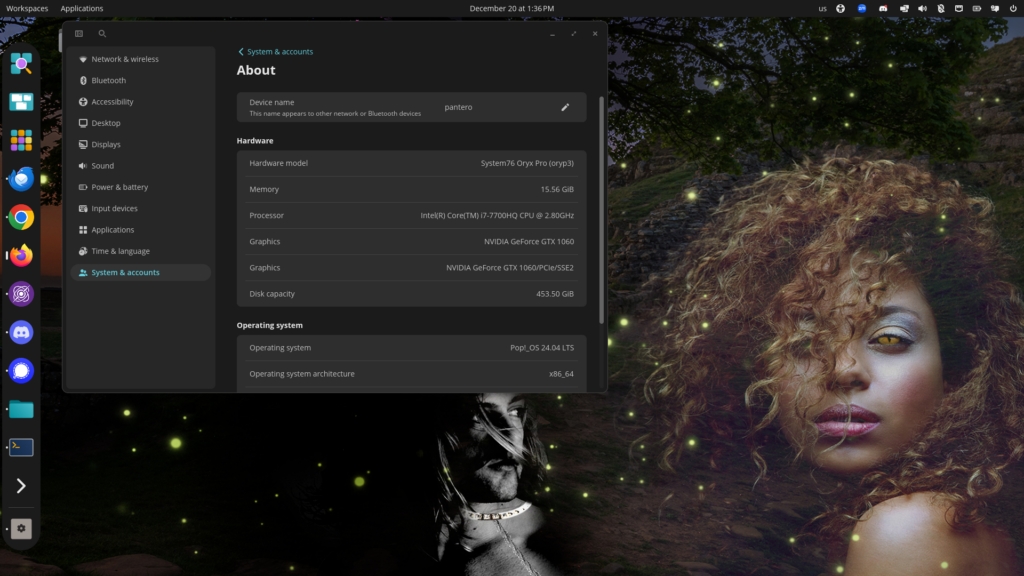
Pop!_OS 24.04 LTS Desktop image

With the end of the semester, I decided to update early to Pop!_OS 24.04 LTS which just became available. I wanted to give myself as much time as possible if it failed or had serious problems. But, knowing System76, I needn’t have worried. The whole process only took a short while and went very smoothly.

At first, I was bit worried when I checked the requirements. My laptop, a 2018-ish System76 Oryx (oryp3) has an NVIDIA graphics card, so I assumed I would want to use the version for NVIDIA. But that version required a 16xx card or higher. The oryp3 only has a GTX1060. Luckily there was a separate generic upgrade that supports this class of hardware.

The biggest difference is that System76 has developed a new desktop interface called COSMIC. I’ve never been particularly happy with GNOME and actually preferred the previous Unity interface quite a bit more. The main reason I wanted to update, however, was to jump to the newer LTS release of Ubuntu upon which it’s based, to make sure I’ll be able to stay current with security patches. And I didn’t want to have to update during the middle of the semester when there might be time pressure if things went south.

So far, I’ve encountered only a handful of minor differences from the previous version. Some of the utilities are different. I needed to install the third-party packages I had installed separately (e.g. Zoom and Pulsar). And some of the configuration options are slightly different. But I’ve not encountered any showstoppers. Everything just works. My audio works. The Camera works. My portrait monitor is seamlessly supported. I can put the dock where I want it. All of my apps just work, including the X-windows app (Digikam) that I run from my home server. I was even able to easily make a screenshot (see above).

Note that the wallpaper is not from COSMIC, but rather is the cover graphic from my new book A Familiar Problem — Buy your copy today! 🙂

Kudos to System76! I never fail to be impressed with the high quality of their hardware and software.

old jelly jar

As I reflect on my year of writing in 2025, it was a somewhat discouraging year. I did quite a bit of fiction writing, but almost none of it got published. I wrote 26,000 words of short fiction and did 20 submissions. Zip.

I also worked on longer fiction. I finished the 19,000 word manuscript for Ecorozire! the third novella sequel of Revin’s Heart. It’s not clear when they might ever see the light of day. I also finished a 43,000 word rough draft of my new novel The Ground Never Lies. It still needs a lot of work and fleshing out, but I haven’t managed to get to revising it.

The high point was that my first novel, A Familiar Problem finally came out. I wrote it in 2022 and it was rejected five times before being accepted for publication. I signed the contract in 2024 and the original scheduled publication date was December 2024. But it was delayed, first until January and then June. And it finally came out December 10, 2025. I had planned to use 2025 to promote it and scheduled myself to appear in conventions. But, over and over again, I was going without the new book to promote. This was rather discouraging.

I also had the discouraging interaction at Worldcon that left a rather bad taste in my mouth. I ended up having to interact with the other author again at LOSCon. If I hadn’t already made the arrangements to travel to Los Angeles, I probably would have canceled going. We got through it, but it really raised the tension — at least for me. I otherwise had a good time. I had many other positive interactions and, uncharacteristically for me, I managed to meet a lot of new people. And it was fun to unbox A Familiar Problem. Having a new book come out counts for a lot.

So, not everything this year was discouraging.

I did write a lot of blog posts — more than 80. Most are about stuff I was doing. A few were about news or writing. I wrote an Awards Eligibility post. OK. That was a little discouraging.

I also wrote an article about bookselling for SFWA Planetside that is scheduled to appear in January. I have a companion blog post that I will release at the same time.

I was re-elected to a full term as Secretary of SFWA. The difference between service last year and this year is striking. When I joined the Board, SFWA had lost essentially all of its leadership and staff. With fresh leadership, we hired new staff who hit the ground running and really engineered a transformation. The Board has been able to return to developing strategy. Whereas, last year was all frenetic activity, this year has been more relaxed. That’s not to say there haven’t been moments of controversy and high drama (like yesterday). But, no matter how bad it’s been, it’s been better than last year.

My service to the Straw Dog Writers Guild continues. I run Straw Dog Writes and serve on the program committee. I ran the online meetup nearly every week for the second — going on third — year. The regular group is small, but lively, with a mix of less frequent participants. On behalf of the program committee, I invited and hosted several talks during the year. I also served on a committee to review candidates to potentially update the website. I was excited and encouraged to draft the recommendation that was taken to the Board but, unfortunately, nothing ever came of it. Maybe that was another discouraging thing.

Wandering Shop Stories is an ongoing pleasure. We have 168 followers on Mastodon and 69 on Bluesky. Asakiyume frequently boosts and offers thoughtful comments on contributions. We’ve held genuinely enjoyable quarterly meetings aligned with the major solar events (solstices and equinoxen). And we’ve brought on one or two new curators. I write to the prompt most days, although occasionally I use snippets of works-in-progress or even bits of published works. It’s a great creative warm-up exercise in the morning. And reading the contributions by other authors and interacting with the small community that has sprung up around the project is always a treat.

I also participate in a number of other writing prompts on Mastodon and Bluesky, including #WritersCoffeeClub, #WordWeavers, #PennedPossibilities, #ScribesAndMakers, #Writephant, #LesFicFri, #WIPSnips, and probably others. The community of writers on Mastodon is particularly strong and supportive.

The year was also the middle half of my phased retirement. It’s weird to think I’ll teach Writing in Biology just once more this spring. I’ve been teaching this particular class since 2002 and am ready to be done. It’s been hard to keep it fresh and, honestly, seeing the end of the road ahead, I haven’t tried very hard. I realized recently that, when I fully retire in August, I will have spent 30 years — basically half my life — employed by the University. That seems like something that calls for further reflection — and should probably be the subject of its own post.

It was a slow year for me. Although I wrote a lot and submitted a lot of stories, the only work I published this year that is eligible for awards is my novel A Familiar Problem.

Brewer, S.D. 2025. A Familiar Problem. Water Dragon Publishing, San Jose. 202pp.

I had another story accepted for publication last spring, for which I’ve signed a contract, but it’s not going to appear until sometime in 2026.

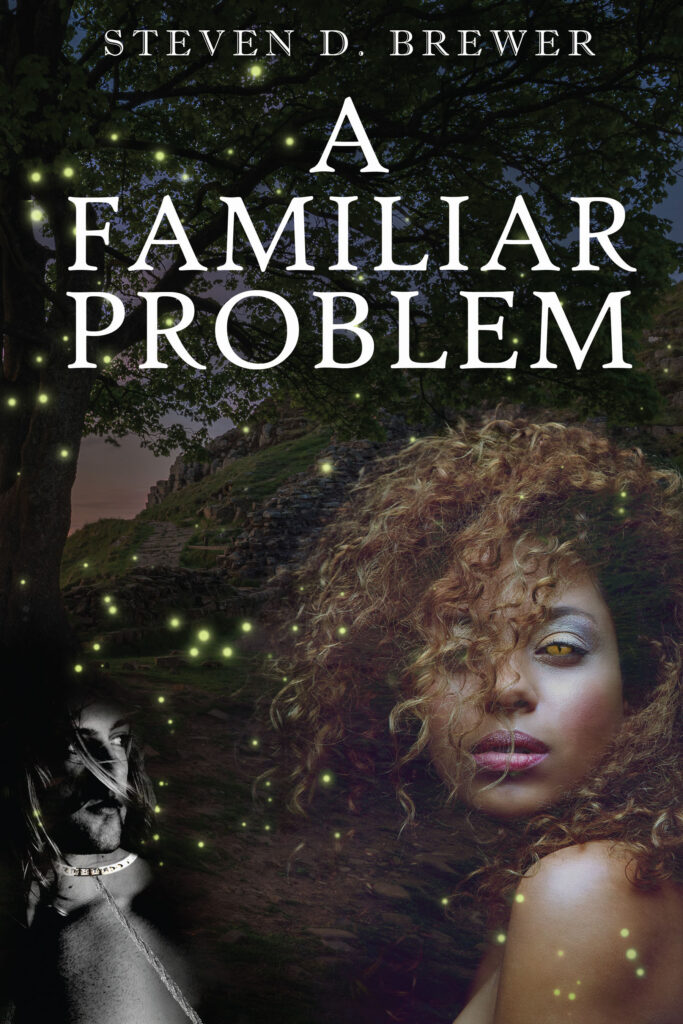
cover for A Familiar Problem

On December 10, 2025, A Familiar Problem is finally available for purchase. It’s been a long, weird road to publication. But I’m very grateful it is finally available and I hope people enjoy it.

In May, 2022, I had an idea for a story. I sketched out a rough outline and then, in just a couple of hours, wrote the first chapter. It was a simple idea: A young man who is supposed to get his magical familiar, instead is captured as the familiar of a powerful demon that intends to train him up to enter him in an illegal familiar-fighting contest.

Over May and June, I wrote the rest of the novel. With a rough draft, I passed it it along to my beta readers. They offered a lot of helpful comments about story structure and pacing.

I had an epiphany while revising. I had originally drafted the story to end at a particular point when the main conflict of the story was resolved. But, while I was revising, I kept thinking of fun, funny things that the characters could do after the end. Eventually, I realized that, as I was the author, I could just keep writing more. In the end I wrote two more fun-filled chapters and created a far more satisfying ending.

During July, I fleshed out the rough draft: I added richer descriptions and worked to make sure that the timeline was consistent. My records indicate I submitted the manuscript for the first time on August 1st. I got five rejections before it caught the attention of an editor and was accepted for publication.

It’s a somewhat strange book. Like all of my writing, it doesn’t fit cleanly into a single genre I had tried to pitch it to one publisher as a “cozy fantasy.” They rejected it saying

We were concerned about the overt themes of sexual abuse and sexual coercion. […] While we recognise that abuse can be a theme in cosy fantasy, a synopsis whereby the protagonist ultimately marries into their abusive situation is more fitting for dark fantasy than cosy.

Currently, I’m calling it a “cozy, dark fantasy.” It does have dark elements but, overall, it’s a story about a young man who discovers that it can be better to want what you have than to have what you want. It’s also about finding the middle way when presented with a seemingly binary choice.

I was super excited to have my first novel published. I scheduled myself to hit the convention circuit during 2025 to promote the book. Then the problems started.

The book was originally scheduled to be released in December 2024. But the release date got pushed back to mid-January ― after Arisia. Then the cover artist artist got sick. Boskone happened. Then the editor ended up in the hospital. The book wasn’t available for Watch City. Or the Nebulas. Or Readercon. Or Worldcon. Finally, in late August, the book production began moving again.

I had hoped it would available for the Northampton Book Festival. Or LOSCon. And, finally, on the morning of the last day of LOSCon, I was able to actually put my hands on a paper copy of the book.

On December 10, 2025, A Familiar Problem hits shelves. Or would, if any brick-and-mortar stores were carrying it. But you can find it online at all of the major book sellers. I hope you’ll buy a copy.

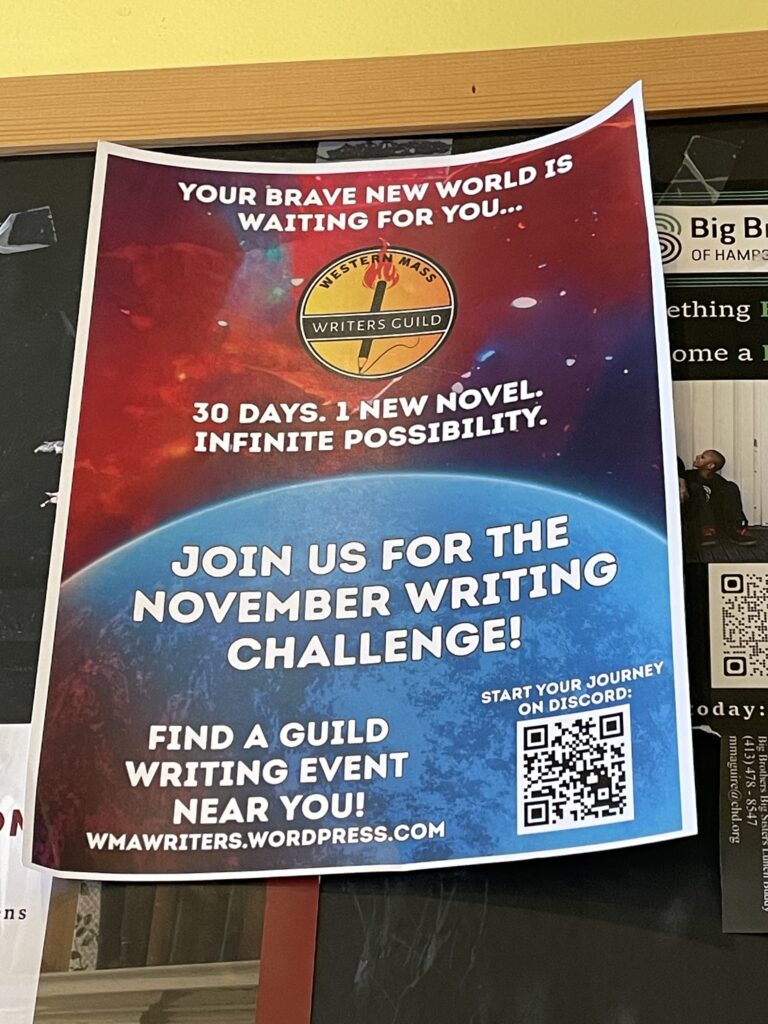
My wife saw a poster in a local restaurant advertising yet another writing group in the Pioneer Valley which I hadn’t heard of: The Western Mass Writers Guild. I poked around their website and saw they had a Discord Link, so I joined it. And then I saw they had a meeting scheduled for today: Support and Accountability for Novel Editing (the first Saturday of each month at 3:30pm at the Forbes Library in Northampton), so I decided to give it a try.

I had seen that several of the regulars were unable to attend, so I wasn’t sure if anyone was coming. But after a few minutes one person showed up, and then another. Two of us were new, but one was familiar with the organization and could give us some background.

The organization began as the Western Mass regional group for NaNoWriMo. But, after the collapse of that organization, they decided to reorganize as the Western Mass Writers Guild. Originally, they were primarily focused on novel writing in November.

They’re mostly a quiet working group: a little socializing and mostly just working on writing together. They don’t do readings or critiques, as a rule, but people can self organize relationships with members if they want to form critique groups.

Most of the activity is on the Discord. There are a number of channels where people can ask questions. They also have a channel where people share useful links to resources.

I stayed for a bit more than an hour and got to show a copy of my new book (A Familiar Problem). Then, I needed to leave. But I will probably attend again, sometime.

With an hour to kill at LAX on my way home from LOSCon, I thought I’d take a few minutes to reflect on the experience. It was generally good: my travel arrangements went well (at least so far) and the accommodations were satisfactory. And in spite of a family member coming down with a cold before I left, I did not become symptomatic during the convention. We’ll have to wait to see whether I managed to dodge the bullet again after I get home.

I had a light schedule this time, with three panels in total, one for each day of the convention.

I was a participant for the first: Biology in Science Fiction and Real Space moderated by Jane Shevtsov. She did a presentation just before the panel which gave me an opportunity to learn more about her. She hadn’t contacted us beforehand, so we didn’t have any sense for how the panel would be organized. But it went reasonably well and I was able to think fast enough on my feet to feel like I made reasonable contributions.

I was the moderator for my second panel: Poetry and Songs in Speculative Fiction. This was a panel I had proposed. I had noticed the one of the participants was on my previous panel, so I made a point of introducing myself. The other two were on another a poetry panel the previous day, so I attended that one to hear them speak and, again, to introduce myself.

There were a couple of disappointing outcomes. The venue was half of a room separated with a divider and the session on the other side was extremely noisy. The con staff made some attempt to ameliorate the noise, but it was still pretty bad. The attendance was also quite poor. The poetry panel on the previous day had also been poorly attended, so I wasn’t surprised. But it was still disappointing.

I had forwarded to them a set of questions the previous week:

Please introduce yourself and, since we mentioned Tolkien in the panel description, was there a poem (among the ~60 or so) in the Hobbit or Trilogy (or elsewhere) that particularly resonated with you and why?

Poetry and meter were probably memory aids for stories in an oral tradition that carried over to the earliest written stories, cough, Gilgamesh. What other reasons do authors use poetry?

Songs present unique difficulties to represent on the printed page. What are some of the challenges to using poetry and songs in fiction? What are some ways it can fail or miss the mark?

Do you write poetry and songs yourself to include in your fiction? would you like to share some?

Movies provide a more natural medium for including music and song. How do their uses differ from printed fiction.

If we haven’t mentioned KPop Demon Hunters yet, what were particularly effective — even revolutionary — uses of song in that movie?

What are other authors and stories that use poetry and song particularly effectively?

They each brought interesting and unique perspectives on the questions. I was surprised that one of the participants had never read The Hobbit or Trilogy. And two of them had not seen KPop Demon Hunters. I was really surprised by that. But we had a good discussion about the topic and I learned a lot.

The last panel I served on was Developing a Creative Habit. This was a great panel. By this point, I had seen all of the participants and so I had a pretty good sense for how the panel would go. My main objective was to present myself as the anti-habit. Although I’m pretty settled in terms of my daily schedule, I’ve learned from long experience that my productivity is extremely variable. I used to stress about it and wanted to encourage others to not worry about it. I described my approach which is to have multiple projects and just write whatever I want whenever I feel like it — or not. This earned the comment, “You, sir, are a weirdo” by M. Todd Gallowglas, which I warmly accepted in the spirit in which it was intended. I also managed to mention Structured Procrastination and Philip’s essay about being routinely creative. And a lot more.

I balanced the rest of my time between other panels and working at my publisher’s table in the Dealer Room. Sales were rather poor — and not just with us. All of the other dealers seemed pretty disappointed by sales.

I was excited to finally get to put my hands on some copies of my long-delayed book A Familiar Problem. It didn’t arrive until Saturday evening, so I could only try to sell them on Sunday. By the time the Dealer Room closed, I hadn’t sold one. That’s how it goes sometimes.

I had several hours between when we finished load out and time for my flight. I decided to leave the hotel and spend most of the time in the airport. I’m kind of glad I did because the traffic to get the one mile to the airport from the hotel was miserable and it took almost an hour. Then, going through security, they had to call over some specialist to check the personal oxygen concentrator I need to fly. That took another half hour. But I got through fine and had more than an hour to spare.

And I’ve finished this post at 10pm with just a few minutes before boarding. Ojalá, I will be back home tomorrow before noon.